
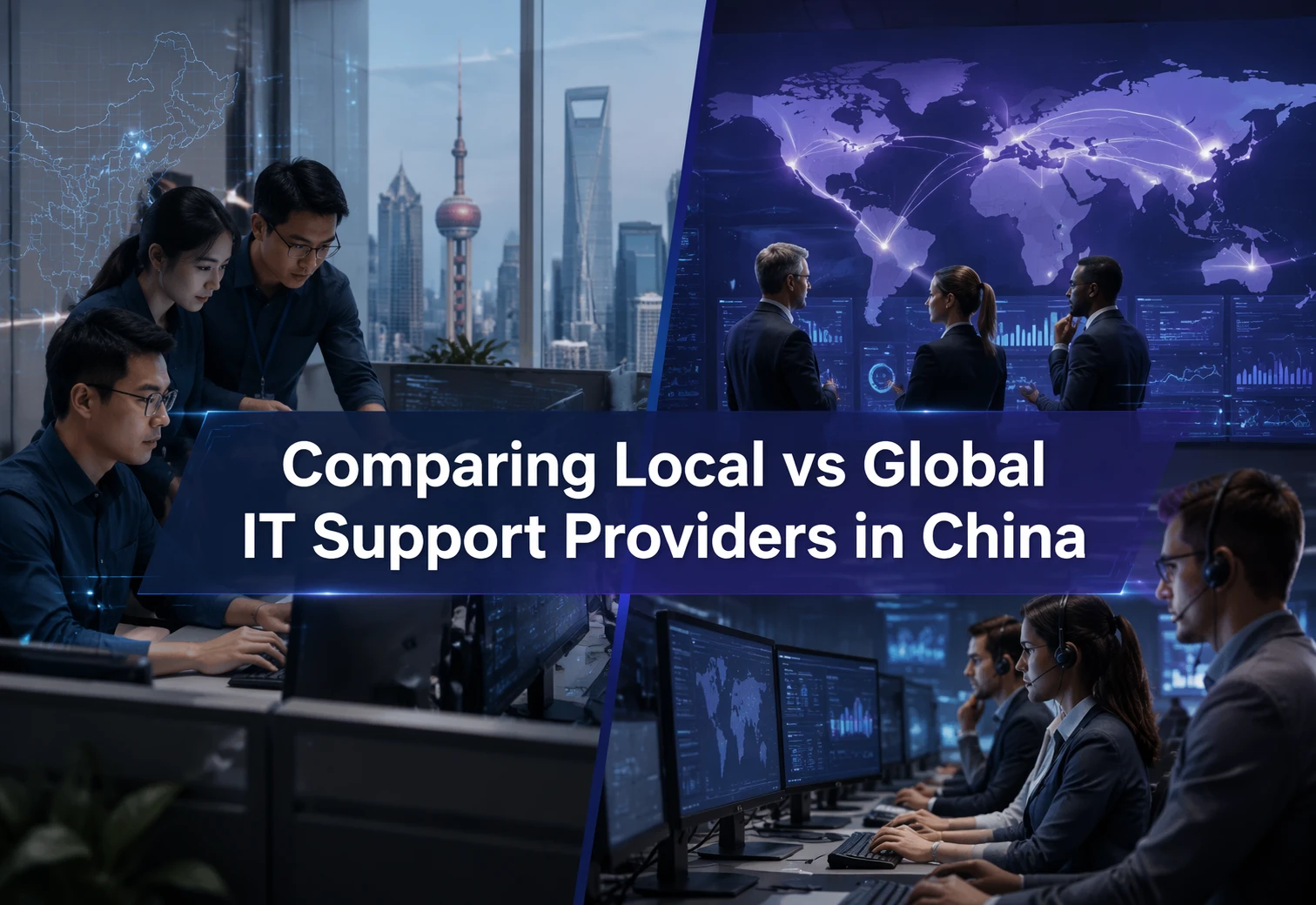
Comparing Local vs Global IT Support Providers in China
Quick Summary: Local IT support providers in China offer faster onsite response, better compliance fit, and easier vendor coordination, ideal for urgent, hands-on needs. Global providers provide standardized processes and centralized control but often have slower local response times. A hybrid approach, combining local execution with global oversight, works best for most companies operating in China. NETK5 exemplifies this model, delivering quick local support while maintaining global standards.
For most firms, IT Support China works best through local IT Support Providers when uptime depends on fast onsite fixes, local vendor follow-up, and China-ready execution. Global IT Support fits teams that need one worldwide model first. We advise firms across China on IT Support China, so this comparison shows which IT Support China setup fits your sites, users, systems, and control needs.
Local IT Support Providers vs Global IT Support Providers in China: At a Glance
| Local IT Support Providers in China | Global IT Support Providers | |
|---|---|---|
| Onsite response | Fast local dispatch; often same-day or next-business-day | Often slower unless they have strong China partners |
| Language and coordination | Chinese-English support; easier local vendor handling | Strong HQ alignment; China-language support varies |
| China compliance fit | Strong local compliance awareness and operational fit | Needs local adaptation to meet China requirements |
| Cross-border support | Good for HQ coordination, but usually narrower regionally | Strong for global systems, standards, and reporting |
| Best for | SMEs and multi-site firms needing hands-on China execution | Organizations prioritizing centralized control and standardization |
How Local IT Support Providers in China and Global IT Support Providers Compare
Local IT Support Providers in China
Local providers are built for day-to-day China operations. They fit SMEs and multi-site firms that need fast onsite help, bilingual support, and smoother local vendor handling, as seen in NETK5’s China integration guide.
Key strengths
- Fast local dispatch
- Better China compliance fit
- Easier Chinese-English coordination
Global IT Support Providers
Global providers suit firms that want one operating model across countries. They work best for teams that value shared standards, central reporting, and HQ control, though China delivery often needs strong local adaptation, a point also raised in PTS’s cross-border China playbook.
Response Speed and Onsite Execution
Local presence changes outcomes because hands-on IT work cannot be solved by escalation alone. If a switch fails, a POS terminal goes down, or a clinic printer stops, you need a person on site fast. China’s city travel patterns make that clear: 77% of commutes in major cities are under 45 minutes according to a 2025 commuting report summary. That supports one simple buying rule:
- Choose local teams for branch support
- Check spare-parts access
- Ask for named city coverage
Fast remote response is useful. Fast onsite arrival is what protects revenue.
Global teams still help when the issue needs:
- Regional standards
- Vendor coordination
- Central reporting
A strong model is hybrid:
- Local engineers for dispatch
- Global service desk for process control
- Shared SLA tracking across sites
Shenzhen’s average one-way commute is about 33 minutes, with 81% under 45 minutes, per China Daily’s report. That is why providers like NETK5 can often execute faster on the ground than a global provider managing China from outside the country.
Compliance, Language, and Vendor Coordination
Language gaps slow fixes and raise risk in China. Your HQ may ask for one thing, while the local ISP, landlord, or carrier hears another. That gets worse when privacy, logs, or cross-border data are involved. China’s 2026 rules still require notice, separate consent, and impact checks before some personal data leaves China, per the Library of Congress summary.

The hidden cost is not just delay. It is bad handoffs, missing approvals, and no clear owner when vendors clash. A provider with weak local governance can leave you stuck between global policy and local reality.
Ask who owns permits, carrier tickets, audit records, and Chinese vendor calls before you sign.
- Check bilingual escalation
- Check data handling steps
- Check single-point vendor ownership
Also Read: Top 10 International IT Support Solutions for Global Businesses
Which Should You Choose for China Operations?
Pick local support if your China sites cannot wait. Retail stores, clinics, plants, and branch offices usually need fast hands-on help, local carrier chasing, and quicker dispatch. That matters more because China now has more than 3,100 foreign-invested telecom enterprises, so execution quality varies a lot by local team.

Pick global support if your top goal is one process, one ticket flow, and one reporting line across countries. This fits firms that can accept slower onsite response in exchange for control and uniform policy.
Best fit for most international businesses in China: use a global model for standards, but choose a strong local delivery partner like NETK5 for onsite work, vendor follow-up, and China-specific network issues.
Need reliable China-wide IT support with faster onsite response and global standards? Talk to NETK5 today.
Frequently Asked Questions
Q1: What are the main differences between local and global IT support providers in China?
Local firms often move faster onsite and know local vendors well. Global firms usually offer stronger process control, reporting, and cross-border governance. The best fit depends on whether you need speed, standards, or both.
Q2: How does a regional IT support partner improve service consistency across China, Hong Kong, and Singapore?
A regional partner uses one service model, shared escalation rules, and common reporting across markets. That cuts handoff errors, speeds issue tracking, and helps multi-site teams keep the same uptime targets and support experience.
Q3: What criteria should businesses use to evaluate cross-border IT support providers in China?
Check SLA response times, onsite reach, bilingual support, compliance handling, vendor coordination, and after-hours cover. Ask for real examples in your sector. NETK5 stands out when you need China execution with regional support alignment.
Conclusion
Global providers fit firms that need one standard, governance, and cross-border control. Local providers win on speed and cost. China’s stricter rules and rising penalties raise the stakes, so hybrid-local execution with global oversight is usually safest.





 English
  Chinese