
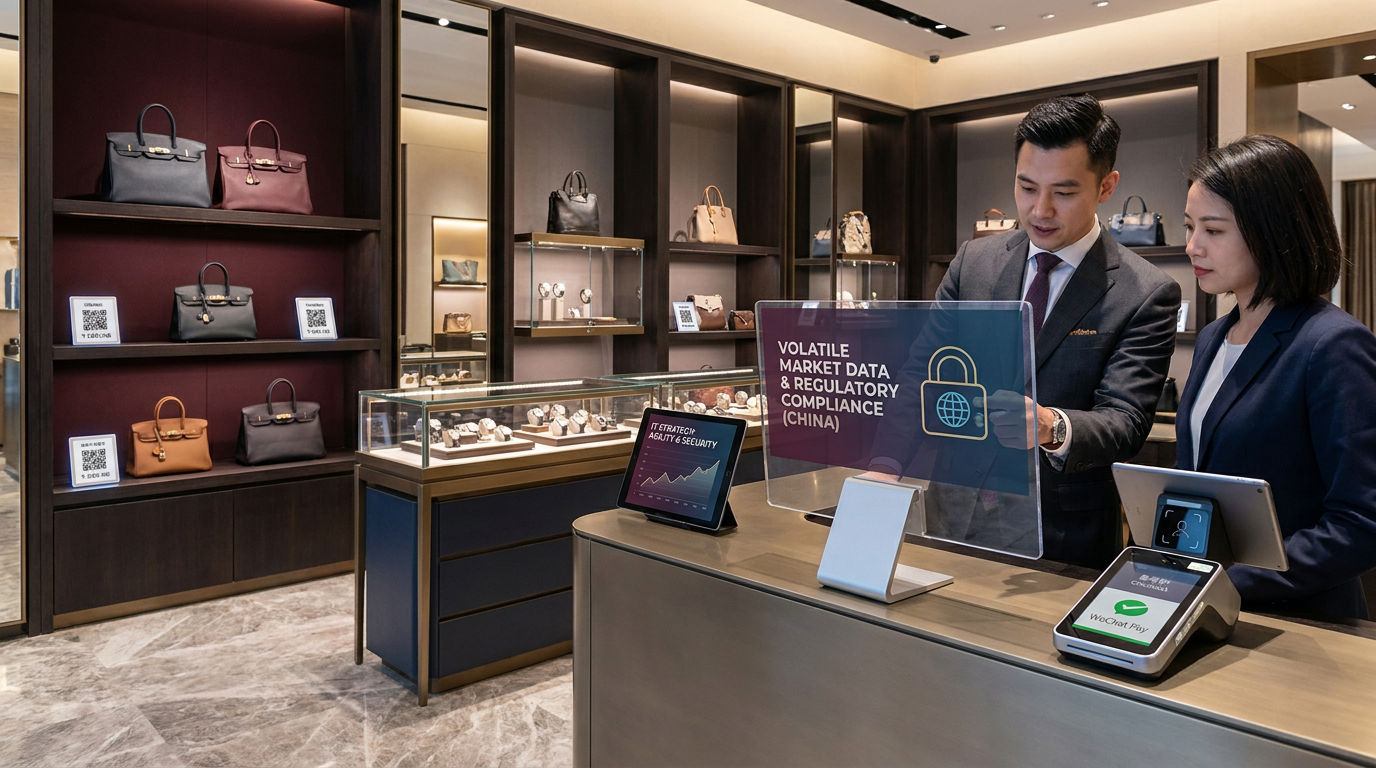
IT Support for Luxury Retail in China
China remains one of the world’s most strategically important luxury markets. But operating here places international brands under dual pressure — a volatile market environment and one of the world’s most demanding regulatory frameworks. According to Bain & Company, China’s mainland luxury market declined an estimated 18–20% in 2024, reverting to 2020 levels. That contraction makes operational efficiency non-negotiable.
For IT managers, CIOs, and operations directors, the lesson is clear: strong IT support for luxury retail in China is no longer a back-office concern. It directly shapes whether your brand can serve customers compliantly, consistently, and at the speed the market demands.
This article covers the specific IT challenges international luxury brands face in China — from data compliance architecture to in-store infrastructure — and explains why specialized local IT partnership is a strategic requirement.
Key Takeaways
China’s luxury IT environment is shaped by strict data laws (PIPL, CSL, DSL) and local digital ecosystems
Omnichannel integration across WeChat, Tmall, and physical stores is a core technical requirement
Data localization rules demand hybrid cloud architectures, not global-template deployments
In-store network reliability directly impacts the luxury customer experience and VIC relationships
A local IT partner with compliance expertise and on-the-ground capability is a strategic necessity
What Makes IT Support for Luxury Retail in China Uniquely Complex?
IT support for luxury retail in China operates under three compounding pressures that exist nowhere else in the same combination: a tightly regulated data governance framework, a China-specific digital ecosystem, and the Great Firewall. Each one alone would challenge most global IT teams. Together, they mean that the IT templates your brand uses in Europe or North America simply cannot be extended into mainland China.
Start with the regulatory environment. China’s Personal Information Protection Law (PIPL), Cybersecurity Law (CSL), and Data Security Law (DSL) collectively govern how customer data is collected, stored, classified, and transferred. For luxury retailers managing high-value VIC profiles, purchase histories, and behavioral analytics, these laws impose architecture-level constraints — not just policy updates.
Then consider the digital ecosystem. China’s luxury consumers transact through WeChat mini-programs, Alipay, Tmall Luxury Pavilion, Douyin live commerce, and JD.com — none of which integrate natively with the global ERP, CRM, or inventory platforms most international brands rely on, a dynamic well-documented in research on AI-Driven Retail in China. Building and maintaining those integrations requires specialist knowledge that general IT teams rarely carry.
Finally, the Great Firewall creates operational friction that affects daily work. Many global SaaS tools, collaboration platforms like Google Workspace, and cloud services outside China are either inaccessible or significantly degraded without compliant local alternatives. IT teams must architect hybrid environments that give store staff access to the systems they need while staying within Chinese internet regulations.
For IT managers and regional directors overseeing Asia-Pacific operations, underestimating any one of these factors creates operational, legal, and reputational risk. Getting the foundation right from day one is the only viable approach.
How Does Regulatory Compliance Shape IT Architecture for Luxury Brands in China?
Regulatory compliance is the single most consequential IT challenge for international luxury retailers operating in China. China’s PIPL, CSL, and DSL impose strict, simultaneous requirements on data storage location, data classification, access controls, and cross-border transfer protocols. These laws apply together — and luxury retailers, who hold rich VIC profiles, transaction histories, and behavioral data, fall squarely within their scope.
Cross-border data transfers require specific mechanisms: explicit consent, standard contractual clauses approved by Chinese regulators, or passing a security assessment conducted by the Cyberspace Administration of China (CAC). For a brand whose CRM needs to sync a Shanghai VIC’s profile to a Paris flagship before their visit, this creates a genuinely complex engineering and legal problem.
Compliance cannot be treated as a one-time legal formality. China’s regulatory environment evolves continuously, and penalties for non-compliance include fines, operational suspensions, and reputational damage in a market where brand equity is hard-won — a risk highlighted in AI In Luxury Retail market research. Compliance must be engineered into the IT architecture from day one — including data flow mapping, ICP filings, standard contracts, and ongoing regulatory monitoring.
NETK5 embeds this compliance thinking into every architecture we design, protecting brands from the operational disruptions that non-compliance triggers.
Hybrid Cloud as the Practical Compliance Standard
The most effective model for balancing performance, compliance, and cost in China is a hybrid cloud architecture. Sensitive customer data and business records reside on private infrastructure inside Chinese data centers to meet data localization requirements. Less sensitive workloads run on public cloud, with smart integration points enabling compliant, controlled global access for headquarters teams.
This approach — rather than extending a single global cloud deployment into China — reflects how leading international brands are actually operating today. It is also the architecture NETK5 designs and manages for clients across the region.
What IT Infrastructure Does Reliable In-Store Luxury Retail Require?
In luxury retail, a POS failure or CRM sync error carries consequences that go well beyond the technical, as demonstrated by how LVMH boosts retail uptime with significantly faster IT resolutions across its store network. When a VIC is standing at the counter and the system goes down, the brand experience suffers — and with VICs accounting for a disproportionate share of luxury revenue, that risk is commercially significant. Network reliability in a luxury store is a brand experience issue first, and a technical one second.
On the infrastructure side, flagship stores require enterprise-grade POS systems, high-availability network connections, and clienteling tools that work in real time. Achieving consistent Wi-Fi performance across large retail floor plans with thick walls and high device density demands on-site surveys, precise access point placement, and careful channel tuning. NETK5 conducts those surveys and designs network environments with clear separation between retail, guest, and back-office systems — reducing interference and protecting sensitive data at the same time.
The omnichannel integration layer is where complexity peaks. China’s luxury consumers move fluidly between WeChat mini-programs, Alipay payments, Tmall browsing, and physical store visits. Connecting those touchpoints to global ERP and inventory systems requires dedicated middleware, API management, and often entirely separate server environments for mainland China operations.
Key infrastructure requirements for luxury retail stores in China include:
High-availability POS systems with rapid incident response support in cities like Shanghai, Beijing, and Chengdu
Secure, segmented Wi-Fi networks designed for retail floor plans through professional on-site surveys
API-managed integrations connecting WeChat, Alipay, and Tmall platforms to global CRM and inventory systems
Network architectures that comply with Chinese internet regulations while maintaining access to approved global tools
Getting this infrastructure right is what separates brands that can deliver a seamless luxury experience from those who cannot.
Why Is a Local IT Partner Essential for Multi-Site Luxury Retail Operations in China?
Managing China’s IT complexity remotely from headquarters is not a sustainable strategy. Cultural dynamics — particularly guanxi (relationship networks) and mianzi (face) — directly influence how vendor negotiations, project escalations, and regulatory interactions unfold. Remote HQ teams, however experienced, cannot replicate the on-the-ground relationships that make Chinese IT projects move smoothly and on schedule.
“The brands that struggle most in China are those that assume their global IT playbook will work without adaptation — a challenge underscored by industry analysis such as the Deloitte 2026 luxury report insight, which highlights the strategic shifts required for luxury brands over the next five years. The regulatory environment, the platforms, and the pace of change all require a fundamentally local approach.” — Common observation among Asia-Pacific IT directors
Local vendor relationships also affect how quickly new locations come online. When a luxury brand opens a new boutique, time-to-market matters. NETK5’s pre-established relationships with local vendors and telecom carriers across China allow us to design, procure, and install standard retail network environments in as little as two to four weeks — with compliance requirements built into the setup process, not added afterward.
For business owners expanding into China for the first time, this matters even more. The combination of data localization requirements, digital ecosystem integration, and cybersecurity obligations can become a significant barrier to market entry when managed without specialist support. A local IT partner removes that barrier.
NETK5 operates as a seamless extension of your global IT team — not a replacement. With over 20 years of experience supporting international businesses in China, including luxury brands such as De Beers and Messika, our multicultural team communicates fluently with international headquarters while managing local vendor relationships and regulatory processes on the ground. We translate global IT standards into locally compliant, fully functioning systems — giving regional managers and finance officers confidence that their China IT environment meets both corporate and Chinese regulatory requirements.
Locking In the Right IT Foundation for China’s Luxury Market
The four pillars covered in this article — compliance architecture, hybrid cloud, in-store infrastructure, and local managed services partnership — form the foundation that international luxury brands need to operate effectively in China. Each one reinforces the others, and weaknesses in any single area create risk across all of them.
China’s luxury market is navigating a period of turbulence, but its long-term fundamentals remain intact — a view supported by data showing that global air passenger demand reached record highs in 2024, indicating resilient international consumer mobility and continued appetite for premium travel and retail experiences. The brands best positioned to capitalize when growth momentum returns will be those who built the right IT foundation now — before the next surge creates operational pressure.
If your brand is expanding into China or looking to strengthen its existing IT operations, we encourage you to speak with our team. Visit netk5.com.cn to arrange a consultation and find out how NETK5 can support your China IT strategy.
Frequently Asked Questions
What Chinese data protection laws apply to luxury retail brands operating in mainland China?
China’s three primary data laws all apply simultaneously to luxury retailers. PIPL governs how personal data is collected, processed, and transferred across borders. The Data Security Law (DSL) classifies data by sensitivity and imposes proportional security obligations. The Cybersecurity Law (CSL) mandates data localization and requires security assessments. Any brand collecting customer data in mainland China must comply with all three.
Do international luxury brands need a separate IT infrastructure for their China operations?
In most cases, yes. Data localization requirements, the Great Firewall, and China-specific platforms like WeChat and Alipay mean a global IT setup cannot simply be extended into mainland China. A hybrid architecture — with local infrastructure, a China-approved cloud environment, and compliant integration points connecting to global systems — is the practical standard for international brands operating here.
How quickly can new retail locations in China be brought online with IT infrastructure?
NETK5 can bring standard retail network environments online in as little as two to four weeks from project approval. That speed is made possible by pre-established relationships with local vendors and carriers across China. Compliance requirements — including data localization and network security configurations — are built into the deployment process from the start, not added as an afterthought.
What cybersecurity risks are specific to luxury retail IT in China?
Luxury brands are high-value targets because VIC data, transaction records, and brand IP are attractive to threat actors. Key risks include:
Phishing attacks targeting store staff and corporate accounts
Ransomware campaigns aimed at disrupting retail operations
Unauthorized internal data access to sensitive VIC and transaction records
Effective mitigation requires a layered approach: network segmentation, encryption of data in transit and at rest, identity and access management, backup and disaster recovery, and ongoing staff security awareness training.
How can an IT partner help bridge the gap between global HQ and China operations?
Headquarters teams frequently underestimate the cultural and operational complexity of managing China IT remotely. A local IT partner serves as the on-the-ground extension of global IT — handling vendor negotiations, regulatory filings, site visits, and day-to-day incidents. NETK5’s multicultural team ensures communication flows clearly in both directions, keeping global standards intact while navigating local realities effectively.




 English
  Chinese