
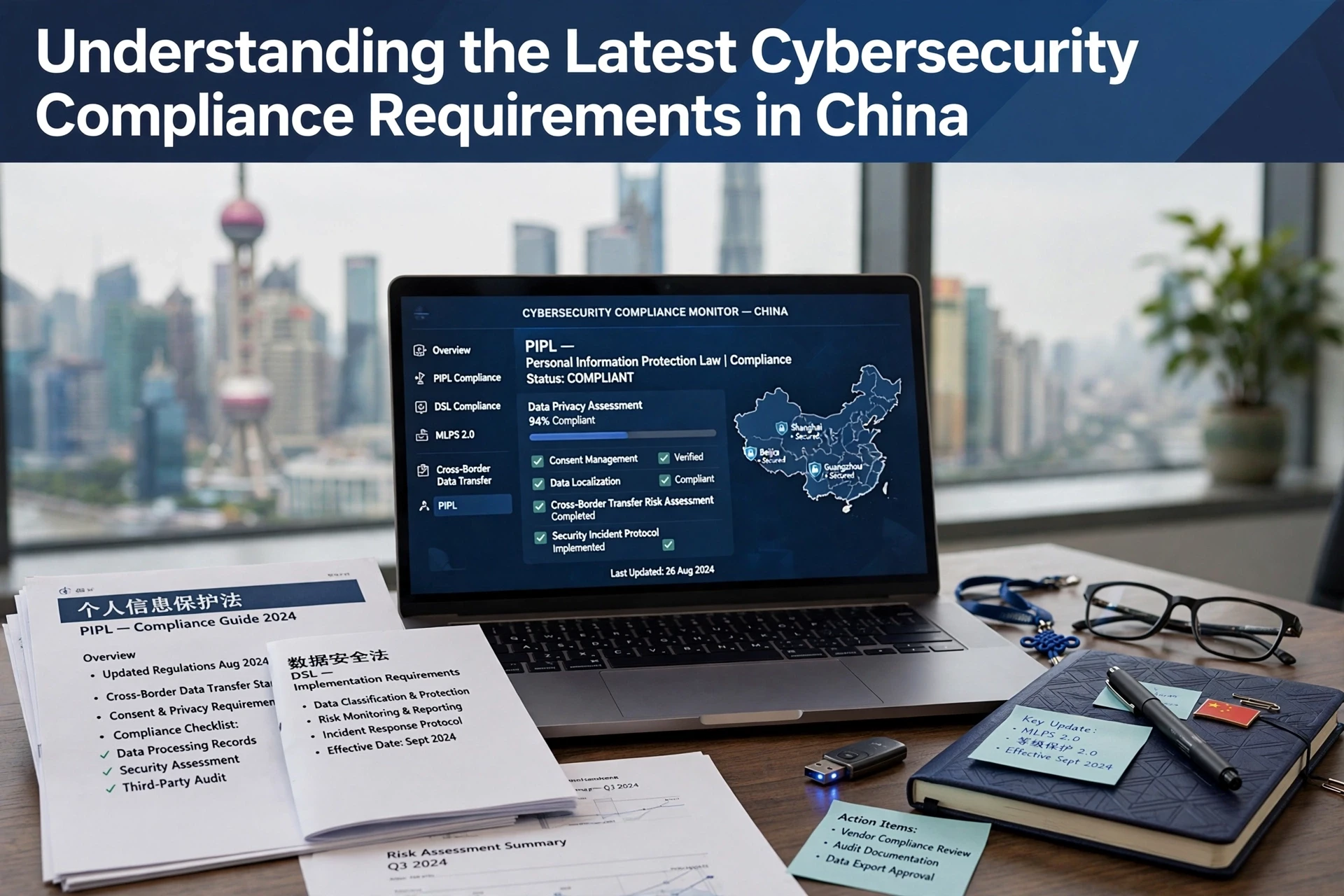
Understanding the Latest Cybersecurity Compliance Requirements in China
Quick Summary: China’s cybersecurity penalties now scale by operator type and harm, not flat fines, so a general network operator might face a warning while a critical infrastructure firm could pay up to RMB 10 million. The 2026 rules also reach overseas conduct that harms China’s security, and regulators demand documented evidence, not promises, for remediation. Businesses should classify data, secure cross-border transfers, and keep dated records for at least three years to reduce risk. NETK5 helps international firms build this audit-ready evidence trail to stay ahead of enforcement.
A retailer that misses required network logs and a critical information infrastructure operator that causes a service outage face very different penalty paths under the amended China Cybersecurity Law. Your operator status decides the consequences. This guide maps who counts as which operator, what China data security rules now demand, and how cybersecurity compliance China requirements rank by risk. NETK5 has supported international firms in China for years, and we break down the tiers so you can prioritize evidence and fixes first.
Which Businesses Can Face Cybersecurity Law Penalties?
Separate China operations from overseas conduct
The China cybersecurity law applies to almost any business running a network inside the country. A “network operator” covers anyone who owns, manages, or provides services through a network, so retailers, clinics, factories, and small offices all fall in scope, not just tech firms. Protiviti’s breakdown notes the term could apply to nearly all businesses in China that operate their own networks.
A second, narrower group faces harsher rules: operators of critical information infrastructure in sectors like energy, finance, transport, and public services. Recent amendments also reach conduct overseas if it endangers China’s cybersecurity and causes serious consequences inside the country.
The law does not regulate purely overseas activities with no China impact. Your HQ’s European network is out of scope unless it touches Chinese systems or data.
Also Read: China AI Oversight News Reshapes Enterprise IT Support Priorities
How the 2026 Penalty Tiers Escalate
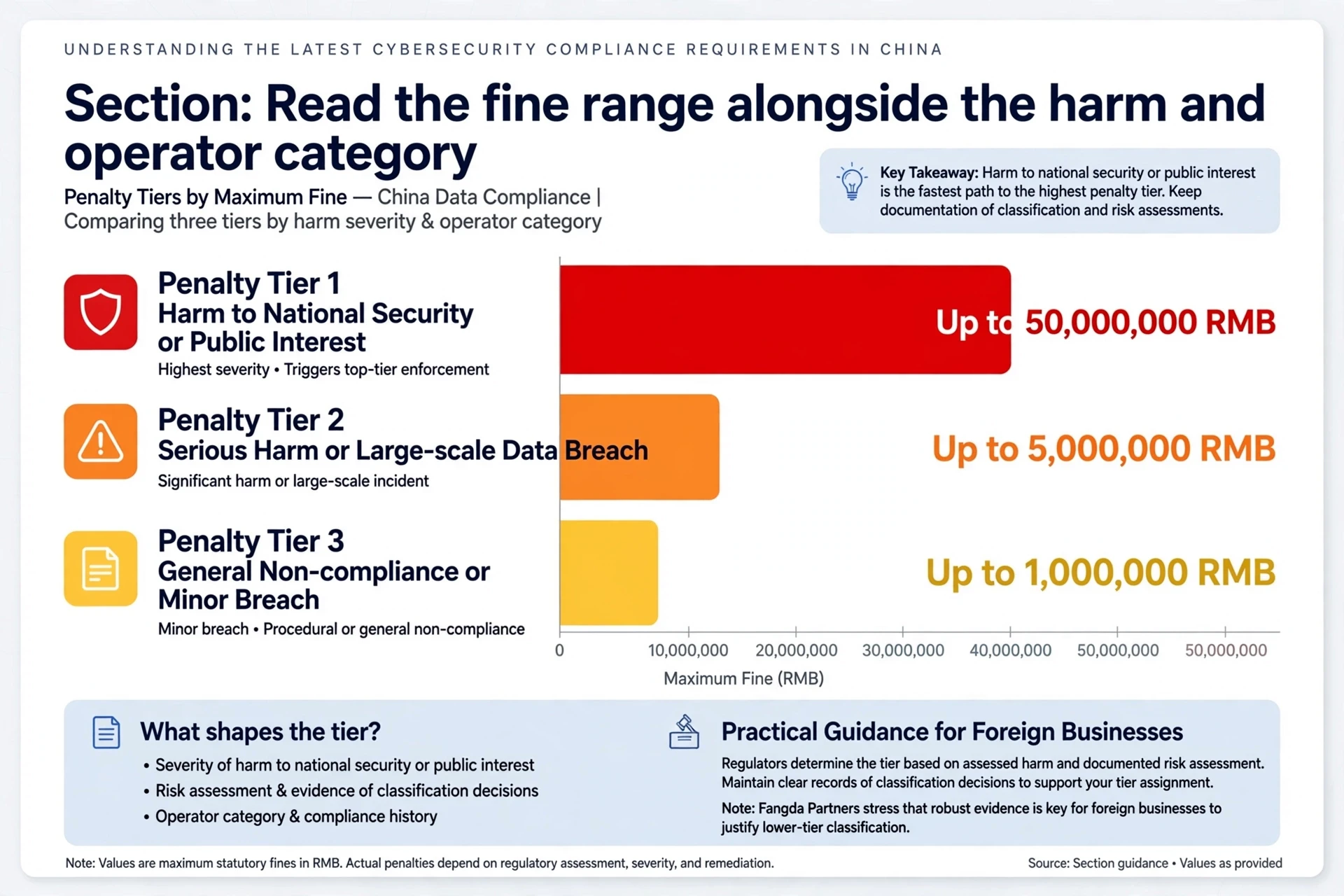
China’s penalty regime under the Network Data Security Management Regulations scales with harm and operator type, not with a single flat fine. The same missed step can cost one company a warning and another a nine-figure sum, depending on who you are and what data you hold. Enforcement is now layered this way under the Regulations’ penalty chapter, as summarized by Asia Growth Partners.
| Tier | Trigger | Typical fine |
|---|---|---|
| First | General non-compliance | Warning, corrections, fines up to RMB 1 million |
| Second | Important-data breaches | Up to RMB 2 million for major leaks |
| Third | Skipped national security review | RMB 1 to 10 million in serious cases |
Repeat or severe cases add suspension, license revocation, and personal fines for the responsible manager.
Read the fine range alongside the harm and operator category
Don’t read the top number and assume it applies to you. Regulators weigh three things together: the actual harm, your data category, and your operator type. A critical information infrastructure operator handling health data sits far higher on the ladder than a boutique retailer with a leaked mailing list. What moves you up fastest is harm to national security or public interest. Keep evidence of classification decisions and risk assessments; it shapes which tier regulators apply, a point law firms like Fangda Partners stress for foreign businesses.
Also Read: Cybersecurity Services in China: Protect Your Business in 2026
Penalties Beyond Fines, and When Mitigation May Be Relevant
Fines get the headlines, but they are not the worst outcome. Under PIPL Article 66, regulators can also suspend services, halt operations for rectification, or push to revoke your business license in serious cases. Individuals face fines too, and responsible managers can be barred from director or executive roles for a period.
- Confiscation of illegal gains
- Public naming in credit records
- Service or business suspension
- Management bans on individuals
Why remediation and incident records matter
Here is the good news. For general violations, regulators first order correction and only fine you if you refuse to fix the problem. So fast, documented remediation is your best defense. Keep dated records of fixes, breach notifications, and impact assessments, since handlers must preserve these records for at least three years. NETK5 helps international firms keep this evidence trail audit-ready.

Also Read: Data Management Strategies for Chinese Enterprises in 2026
A Practical Penalty-Risk Check for Businesses in China
Ask five questions now, not after a breach:
- Do you send personal data to HQ or another office abroad? If yes, one of three transfer mechanisms (assessment, standard contract, or certification) must be in place. Doing nothing is what got Dior Shanghai penalized in September 2025 after a data breach.
- Did you get separate consent for those transfers, clearly explained? A global privacy policy is not enough.
- Do you encrypt or de-identify stored customer data? Regulators checked for both.
- Can you notify regulators and affected people fast if data leaks?
- Who owns this locally? Name one person.
Fix the gaps, and document the fixes. Evidence matters as much as controls – the 2025 enforcement wave now penalizes companies that can’t show their work.

Facing enforcement risk in China? NETK5 helps international businesses close compliance gaps. Visit NETK5 to start now.
Frequently Asked Questions
Q1: What are the penalties for non-compliance with China’s cybersecurity laws?
Fines, business suspension, or license revocation. Serious cases bring personal fines for responsible managers.
Q2: Does China’s cybersecurity law apply to foreign companies?
Yes. Any business processing data in China falls under it, including foreign-owned SMEs.
Q3: How to comply with China’s Data Security Law?
Classify your data, restrict cross-border transfers, and document safeguards. NETK5 helps international firms set this up.
总结
China’s enforcement era is here. Recent fines under PIPL, the amended Cybersecurity Law, and cross-border transfer rules show regulators check evidence, not promises. Map your data flows, match your operator category, and fix gaps early. Cooperation and prompt remediation can reduce penalties, as record Ctrip fine shows.






 Chinese
  English