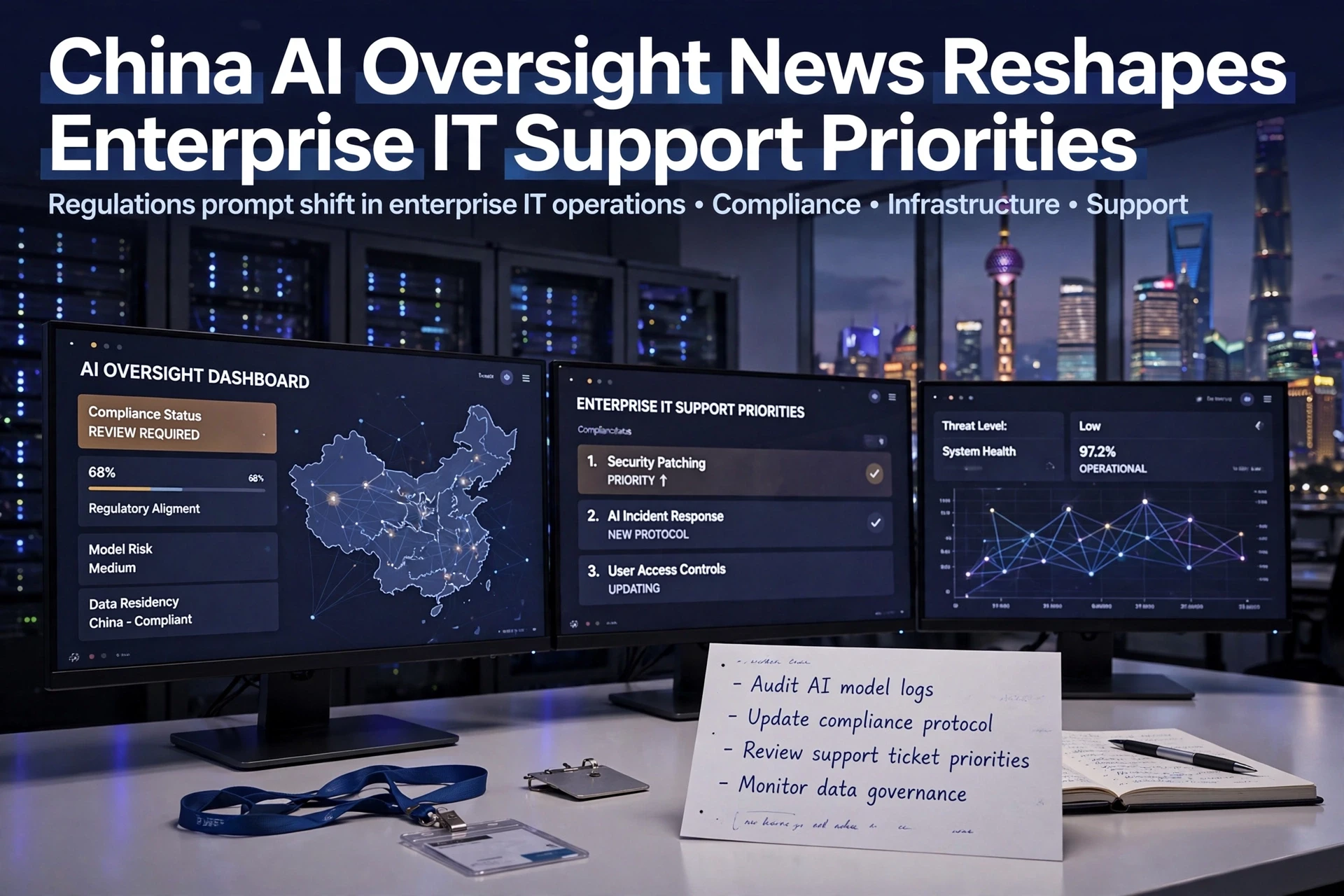
China AI Oversight News Reshapes Enterprise IT Support Priorities
Quick Summary: China’s AI rules now force IT teams to handle compliance, not just legal teams. Since September 2025, all AI-generated content needs visible and hidden labels, and new 2026 laws require filing, safety checks, and fast incident reporting. Enterprises must build an AI tool inventory, map data flows, and log everything, with major incidents reported to regulators within four hours. NETK5, an IT support provider for international firms in China, says these controls are now core support deliverables, not optional extras.
China’s AI oversight has moved from principles to hard rules. The labeling measures that took effect September 1, 2025 force providers to mark AI-generated content, and the broader China AI policy for 2026 stresses filing, safety checks, and traceability. The catch: staff may feed sensitive data into AI tools without anyone logging it. This article shows what enterprise IT support must now do under AI oversight – find AI use, control data flows, keep evidence, and respond fast. At NETK5, we run these controls daily for international firms in China.
China’s New Labeling Rules Turn AI Traceability Into an IT Requirement
Since September 1, 2025, China’s Measures for Labeling AI-Generated Content require every piece of AI-made text, image, audio, and video to carry a traceable mark. This is not just a legal issue. Your IT team now controls compliance.
What Must Be Visible and What Must Be Embedded
The rules split labeling into two types:
| Label Type | What It Is | Example |
|---|---|---|
| Explicit | Visible text, sound, or graphics users can see | “AI generated” tag on a video start screen |
| Implicit | Hidden metadata inside the file itself | Provider name and content number in file metadata |
Platforms that publish content must verify these metadata labels before release. Deleting or faking labels is banned. For teams running AI tools in China, that means audit trails, metadata checks, and file-handling controls belong in your IT support plan.
Also Read: Cybersecurity Services in China: Protect Your Business in 2026
Enterprise IT Support Must Add AI Inventory, Access, and Data-Flow Controls
China now enforces AI rules in layers. The amended Cybersecurity Law took effect on January 1, 2026 with a dedicated AI compliance provision, and regulators penalized thousands of accounts for unlabeled AI content just weeks later, according to ICLG’s 2026 review. Your IT support team needs a working register, not a policy PDF.
The Minimum China AI Support Register
| Control | What to Record | Owner |
|---|---|---|
| AI inventory | Every AI tool, chatbot, and plug-in in use, approved or not | IT lead |
| Access rules | Who may use which tool, with named accounts and logs | IT lead + HR |
| Data-flow map | What data enters each tool, and where it goes | Data manager |
Start with three steps:
- List every AI tool staff actually use, including personal accounts.
- Block or approve each one, then log who accesses what.
- Map which data feeds the tools, especially client and staff data.
Keep this register current. Regulators expect it, and auditors will ask. China’s labeling rules already require you to know where AI content and data travel.

Also Read: Latest Developments in IT Support Strategies in China
Logging and Incident Response Become Core Support Deliverables
New rules have turned logging and incident response into core IT support work, not extras. China’s incident reporting measures, in force since November 1, 2025, require network operators to report “relatively major” incidents within four hours, and critical infrastructure operators within one hour. Support contracts must now cover this.
A Practical Escalation Path for AI Incidents
- Detect and log. Your monitoring must capture AI misuse, data leaks, and outages with timestamps.
- Triage within minutes. Classify the incident against the four severity levels.
- Notify. Reach the threshold? Your provider must report to the provincial CAC within four hours.
- Preserve evidence. Keep logs intact for the follow-up report and 30-day summary.
Under China’s new cybersecurity incident reporting framework, providers themselves must report incidents they discover. NETK5 bakes these timelines into every support agreement.
Also Read: Comparing Local vs Global IT Support Providers in China
What French Companies Should Change Before the Next AI Deployment
China’s AI rules arrive in layers, not one law. Each new tool you deploy can trigger a different filing, standard, or review. Plan for that before rollout, not after.
Start with four changes:
- Map each AI tool to its rule. Content generation, deepfakes, and recommendation engines each fall under different measures, so one checklist won’t cover a mixed stack.
- Check filing obligations early. Public-facing generative AI services need a security assessment and CAC filing before launch; 796 services had already registered by early 2026, per the Deep Lex regulatory tracker.
- Label AI-generated content. Since September 2025, explicit and metadata labels are mandatory, and enforcement is active.
- Log and localize. Keep records ready for inspections under the amended Cybersecurity Law, effective January 2026.
Internal-only AI tools face lighter rules, but data security and personal information laws still apply. A local partner such as NETK5 can help French teams wire these controls into their China infrastructure before go-live.
Miss one layer and you are non-compliant, even if you follow all the others – China’s regulators test each system against its own rule, as the 2026 regulatory roundup notes.
New AI rules in China demand expert IT support. NETK5 helps you stay compliant and secure. Contact our team today.
Frequently Asked Questions
Q1: How is China’s AI oversight changing enterprise IT support requirements?
IT teams now need stronger data controls, clear AI vendor audits, and documented compliance. Support providers like NETK5 help foreign firms keep systems aligned with new Chinese rules.
Q2: What does China’s new AI regulation mean for foreign companies in IT?
Foreign companies must review AI tools, label generated content where required, and keep data stored securely in China. Local IT support partners make meeting these duties far simpler.
Q3: How can businesses in France adapt to China’s AI compliance rules?
Start with a compliance audit of AI systems, then update data handling policies and train staff. NETK5 guides French SMEs through each step across their China operations.
总结
China’s AI rules, including the Interim Measures for generative AI services, keep expanding. For firms in China, that means clear IT priorities: label AI content, file with regulators, and secure your data. Cambridge research confirms more rules are coming, so a partner like NETK5 keeps you ready.






 Chinese
  English