
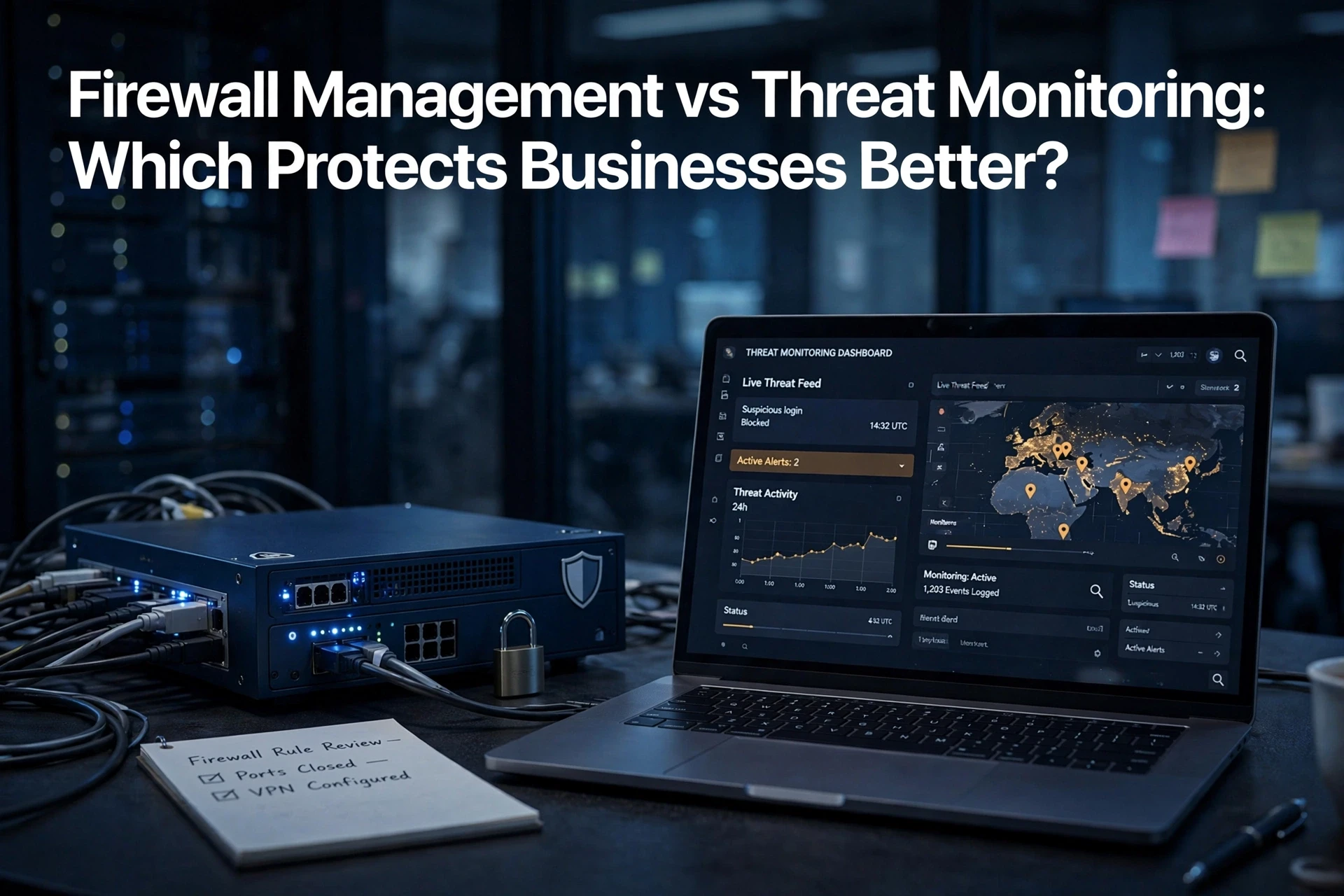
Firewall Management vs Threat Monitoring: Which Protects Businesses Better?
Quick Summary: Firewall management keeps rules, patches, and perimeter devices in shape, while threat monitoring watches endpoints, cloud, and accounts around the clock for suspicious behavior. Neither replaces the other: firewalls miss internal attacks, and monitoring does nothing if nobody patches the router. The article concludes most SMEs, especially French ones, should pair both, and it notes NETK5 offers managed firewall upkeep and continuous monitoring under one team.
Firewall management closes gaps like stale rules; threat monitoring catches odd activity on laptops, cloud accounts, and servers after hours. Neither replaces the other. This comparison shows what each service operates, what it sees after an alert, and which one fits your firewall management needs, budget, and limited IT coverage.
Firewall Management vs Threat Monitoring: At a Glance
| Firewall management | Threat monitoring | |
|---|---|---|
| Primary purpose | Keep firewall controls configured and maintained | Detect and investigate potential security incidents |
| Typical scope | Firewall appliances, policies, and related network perimeter | The endpoints, network, cloud, and accounts connected to monitoring |
| Core activities | Rule changes, policy review, patching, tuning, and health checks | Alert monitoring, triage, investigation, and reporting |
| Incident response | May handle firewall alerts or incidents; confirm scope and authority | Can include containment; confirm the service’s authority and SLA |
| Best fit | Organizations needing reliable firewall operations and governance | Organizations needing visibility and security coverage beyond office hours |
How Firewall management and Threat monitoring Compare
Firewall management
This is the ongoing care of your firewall: rules, updates, patching, and device health. It suits organizations that need their network perimeter configured correctly and kept that way. If nobody is tuning your firewall, even the best hardware loses value.
Key strengths
- Keeps firewall rules and policies current and reviewed
- Covers patching, tuning, and regular health checks
Threat monitoring
This is the constant watch on your security data to spot and investigate suspicious activity across endpoints, network, cloud, and accounts. It fits businesses that need visibility and response beyond office hours, including SMEs without an in-house security team.
Key strengths
- Detects and investigates potential incidents around the clock
- Alert triage, reporting, and possible containment, subject to a clear SLA
What Each Service Sees and Actually Does
Firewall management is about configuration. A technician sets the rules, blocks risky ports, applies updates, and reviews logs. The firewall sits at your network’s edge and only sees traffic that tries to cross it. If an attack stays inside your network, the firewall notices nothing.
Threat monitoring goes wider. It watches servers, user accounts, devices, and endpoints around the clock. Instead of blocking traffic, it looks for behaviour that signals a problem: odd login hours, files moving where they shouldn’t, malware calls to strange addresses. When it finds one, a security team investigates and responds.
In short, one service builds and maintains a wall; the other watches everything behind it. Most SMEs need both, configured well and reviewed often. See how cybersecurity services combine the two.

| Aspect | Firewall Management | Threat Monitoring |
|---|---|---|
| Main job | Set and maintain rules | Detect and respond |
| View | Traffic at the edge | The whole network |
| Mode | Scheduled work | Continuous, 24/7 |
| Blind spot | Internal attacks | None if well run |
Coverage, Response, and the Questions Behind 24/7
“24/7” means little on its own. Some providers mean staffed analysts watching alerts around the clock. Others mean software that emails you at 3 a.m. and expects you to act.
Ask three questions. First, who responds when an alert fires – a human, or an automated ticket? Second, how fast, in minutes, not “same day”? Third, what is covered: your firewalls only, or endpoints, cloud, and email too?
A firewall management service can be perfectly “covered” yet blind to a laptop that malware already infected. Threat monitoring flips the risk. It spots the infection but does nothing if nobody patches the router.
The strongest SME setup pairs both. NETK5, for example, combines managed firewall upkeep with continuous monitoring under one team, so nothing falls in the gap. Use that same standard when you compare cybersecurity providers.
Which Should You Choose: Firewall Management or Threat Monitoring?
Pick based on your risk, not on the tech. If your team lacks the skills to configure rules correctly, start with firewall management. It closes the obvious doors: open ports, weak rules, forgotten updates. Most attacks still exploit these basics.
Choose threat monitoring if you handle sensitive customer data or face targeted attacks. Firewalls miss what slips through or leaves your network from the inside. Monitoring catches those cases early.
| Situation | Better Fit |
|---|---|
| No in-house IT staff | Firewall management |
| Sensitive customer or operational data | Threat monitoring |
| Tight budget, common threats | Firewall management |
| Regulated industry (health, retail) | Both, combined |

Most French SMEs need both, in stages. Start with a solid firewall setup, then add monitoring. NETK5 offers cybersecurity services that cover both, so you can grow coverage as your risk grows.
Unsure whether your business needs stronger firewall rules or round-the-clock threat monitoring? NETK5 provides both, backed by 20 years of experience. Talk to our security team at NETK5 today.
Frequently Asked Questions
Q1: Best 24/7 security monitoring partner?
Look for certified analysts, clear response times, and coverage across your time zones. NETK5 provides 24/7 monitoring for French SMEs.
Q2: Can I use both together?
Yes. Firewalls plus monitoring gives layered protection, and most businesses need both.
Q3: Which costs more long term?
Monitoring typically costs more monthly, but it catches threats firewalls miss.
Next Steps for Choosing the Right Coverage
Firewall management builds and maintains your defenses; threat monitoring spots attacks in real time. French SMEs need both, layered together. Ask providers exactly which tasks they cover, and close any gaps before an incident finds them.



 Chinese
  English