

Conference Rooms Vs Production Floors: Very Different Wi‑Fi Demands
Conference rooms and production floors have fundamentally different Wi-Fi needs. Your meeting spaces require burst capacity (3 Mbps per user) for video conferencing with ceiling-mounted APs handling 25 clients per radio. Meanwhile, production environments demand consistent throughput, redundant coverage layers, and specialized antenna configurations to eliminate failure points. You’ll need separate network designs with appropriate QoS policies, mounting positions, and bandwidth allocation strategies for each environment. Discover how proper equipment deployment addresses these distinct challenges.
Key Takeaways
- Conference rooms require burst capacity (3 Mbps per user) for video conferencing, while production floors need sustained application bandwidth.
- Meeting spaces experience dramatic connectivity bursts with many users joining quickly, while production floors maintain steady user engagement.
- Wi-Fi architecture differs fundamentally: conference rooms need high AP density, while production environments prioritize reliability and redundancy.
- Conference rooms utilize ceiling-mounted APs with omni antennas, while production floors require higher mounting with downtilt or directional antennas.
- Dynamic bandwidth allocation works for conference rooms, while production environments need guaranteed QoS through network slicing for mission-critical systems.
Capacity Planning for Meeting Spaces vs. Operational Environments
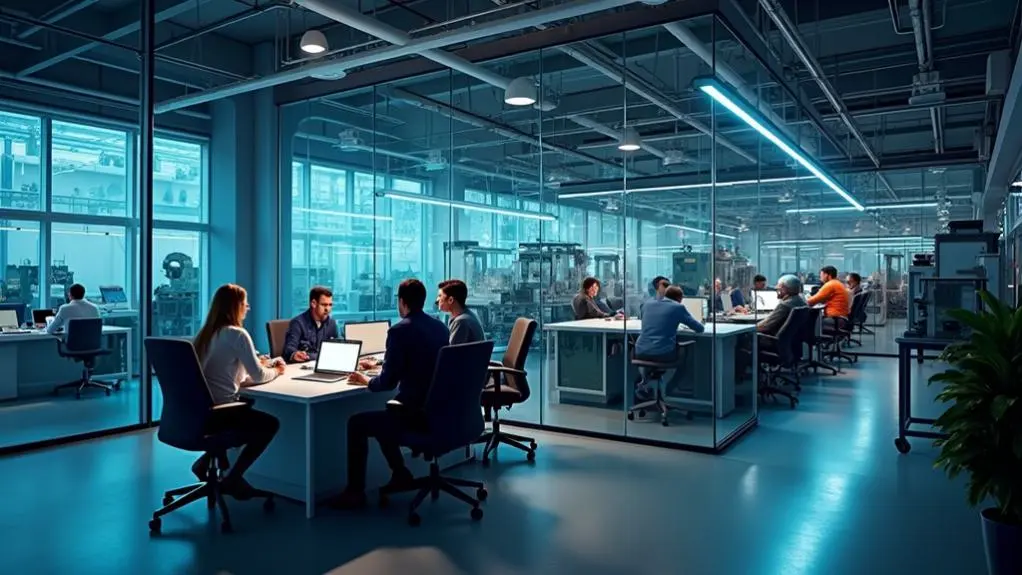
When designing Wi-Fi networks for different environments, capacity planning emerges as the critical differentiator between meeting spaces 和 operational floors. You’ll need to prioritize capacity over coverage in these high-density areas, creating separate requirement profiles for each space type.
For conference rooms, plan for burst capacity with video conferencing demands and higher client densities in smaller areas. You’re looking at approximately 3 Mbps per user in rooms that might hold 50 people simultaneously. Meanwhile, operational floors require more distributed capacity planning with sustained application usage patterns.
Map your design considerations around the maximum user capacity for each space, keeping client limitations to 25 per radio. Implementing Quality of Service policies can help prioritize critical applications during peak usage times. Remember to calculate capacity requirements separately for each area rather than generalizing across your entire building, ensuring your network delivers precisely where needed.
User Density Challenges: Bursts vs. Sustained Load
User density patterns create fundamentally different Wi-Fi challenges in conference versus production environments. Your conference spaces experience dramatic bursts of connectivity as hundreds of users simultaneously join networks within minutes, while production floors maintain steady, predictable client engagement throughout operational periods. High-density environments can experience up to 100-150 clients per access point during peak usage times.
| Environment | Client Density | Usage Patterns | Design Priority |
|---|---|---|---|
| Conference | High/variable | Burst traffic | Peak capacity |
| Production | Moderate/stable | Sustained load | Reliability |
| Conference | 25 clients/radio | Event-driven | Adaptability |
| Production | Distributed | Continuous | Consistency |
Understanding these fundamental differences helps you properly dimension your wireless infrastructure. Where conference rooms require networks that handle 10-20 Mbps across 50 simultaneous clients during peak moments, production environments need consistent throughput that accommodates predictable data streams from sensors and equipment without interruption.
Coverage Architecture: Seamless Meetings vs. Total Venue Reliability
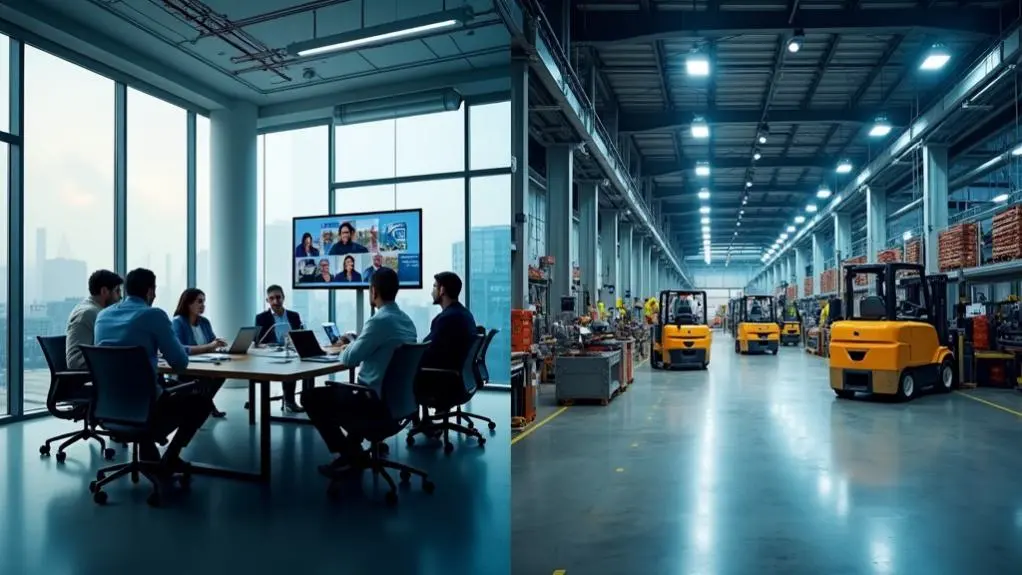
Coverage architectures for Wi-Fi deployment differ fundamentally between conference environments and production floors.
Wi-Fi architecture requires fundamentally different approaches when connecting people versus powering production processes.
In meeting spaces, you need higher AP density with carefully engineered overlap zones ensuring seamless roaming between rooms without dropping connections. Your focus is maintaining signal quality during participant movement through directed coverage and interference management that prevents co-channel conflicts in confined spaces.
Production environments demand total reliability across larger areas where consistent coverage trumps seamless handoffs. You’ll need redundant coverage layers to eliminate single points of failure, with directional antennas focused on critical production areas. Site surveys are essential in both settings but serve different purposes—mapping potential dead spots in meeting rooms versus ensuring extensive venue-wide reliability where equipment connectivity directly impacts operations. Conducting thorough APOS method assessments helps determine optimal access point placements for both environment types.
The key difference: conference deployments prioritize user mobility while production floors require uninterrupted machine connectivity.
Bandwidth Allocation Strategies for Different Space Types
Bandwidth allocation strategies represent the next fundamental layer of network design after establishing proper coverage architecture. Your conference rooms require dynamic allocation methods that manage upstream bandwidth below 1 Mbps per videoconferencing session, supporting multiple concurrent meetings even on modest connections.
For production environments, implement zone-based deployment with private cellular networks handling high-density areas containing thousands of devices. Network slicing provides guaranteed QoS configurations, creating dedicated bandwidth segments for mission-critical systems. This approach supports ultra-low 1ms latency needed for robotic control. TDM-PONs offer a cost-effective solution for industrial deployments while maintaining the performance needed for manufacturing applications.
While conference rooms benefit from QoS that prioritizes video traffic, production floors demand more sophisticated SD-WAN solutions to manage real-time control amid massive IoT density. Consider implementing DBA systems that automatically shift resources from lightly loaded to heavily loaded network segments as demands fluctuate throughout your facility.
Equipment Deployment Trade-offs for Optimal Performance
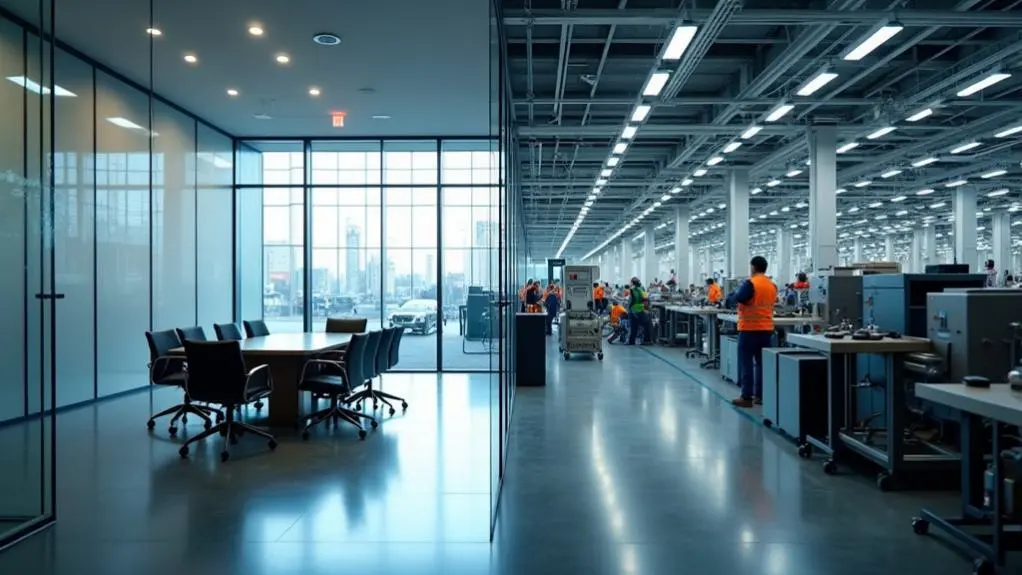
When deploying wireless infrastructure across diverse environments, organizations face critical equipment trade-offs that substantially impact overall network performance and reliability. Your equipment selection decisions must align with the distinct needs of each space type while maximizing signal optimization for intended use cases.
- Conference rooms benefit from ceiling-mounted access points at 8-15 feet with integrated omni antennas, providing consistent coverage for stationary users
- Production floors often require higher mounting positions (15-25 feet) with external downtilt antennas to overcome machinery interference
- Warehouses demand strategic placement using directional patch antennas to focus coverage down aisles while minimizing co-channel interference
- Temperature-controlled areas need external antenna placement with coaxial cables (under 50 feet) connected to access points mounted outside these environments
You’ll need professional site surveys to validate these configurations before full-scale implementation. Proper planning should aim to achieve at least 25 dB SNR throughout all coverage areas for optimal connectivity and application performance.
Frequently Asked Questions
How Do Furniture Layouts Impact Wi-Fi Coverage in Conference Settings?
Your furniture arrangement markedly blocks wireless signals through dense seating, metallic elements, and high-back chairs. Opt for modular layouts with 48-inch clearances and consider mesh systems to counter dead zones.
Can Existing Cellular DAS Support Wi-Fi Backhaul Needs?
No, you can’t use existing DAS for Wi-Fi backhaul. Your cellular technology operates on licensed bands with separate architecture, fundamentally incompatible with Wi-Fi systems despite potential network efficiency benefits.
How Often Should Wi-Fi Infrastructure Be Upgraded in Production Environments?
You thought your office printer’s lifespan was dramatic? Your production network lifetime demands upgrades every 3-5 years due to IoT device proliferation. Upgrade frequency accelerates in high-density settings with thousands of connections.
Do Iot Devices Require Separate SSIDS From Regular User Traffic?
You don’t technically need separate SSIDs for IoT segmentation, but they’re highly beneficial. You’ll achieve better security by isolating IoT devices from user traffic through network controls, regardless of SSID configuration.
What Security Measures Protect Against Rogue Devices in Multi-Tenant Spaces?
Like a vigilant sentry, your security arsenal must include AI anomaly detection, wireless scanning, NAC with strict authentication, and real-time behavioral analysis to enable rogue device detection and enforce secure access across tenants.
总结
You’ll face disaster if you treat conference rooms and factory floors identically. Your meeting spaces demand burst capacity for 100+ simultaneous connections, while production areas require bulletproof reliability across vast spaces. Implement dedicated VLANs with QoS prioritization, deploy directional antennas in high-density zones, and establish rigorous interference monitoring. Without these targeted strategies, you’re fundamentally building a Formula 1 car with tractor parts—technically both vehicles, but catastrophically mismatched for their environments.


 Chinese
  English