
Global IT Operations China Integration Guide 2026
Introduction
Rolling out a new office in Europe or North America often feels predictable. Policies, platforms, and vendors line up with what the global team already knows. For global IT operations China integration, though, the rule book changes fast.
China mixes several tough challenges. The Great Firewall slows or blocks global tools, strict data laws (CSL, DSL, PIPL) limit where data can live, and local IT often grew without central control. At the same time, China is pushing hard on industrial internet and AI, which adds fresh expectations around connectivity and data handling. Yet China still matters for manufacturing, supply chains, and a huge customer base, so walking away is rarely an option.
We wrote this guide for CIOs, IT managers, operations leaders, and owners who need clear, field-tested answers for 2026, not theory. With over twenty years on the ground, we at NETK5 help international companies turn chaotic sites into stable, compliant, and secure environments. By the end of this article, you should see the real risks, the practical steps to manage them, and how a local partner can make global IT operations China integration feel controlled instead of painful.
Key Takeaways
Before diving into detail, it helps to see the main points in one place. These highlights show how we approach global IT operations China integration from both a strategic and very practical angle.
- China brings legal, technical, cultural, and political layers that never sit in separate boxes. We treat them as one connected problem with a single, consistent plan.
- CSL, DSL并 PIPL shape how data can move and where it can live. We treat these rules as part of core design, not a late audit item. That mindset keeps projects faster and safer.
- The Great Firewall breaks many “standard” global network designs. Instead of fighting through it with risky workarounds, we design China‑friendly network paths and hosting models.
- Phased migration and a zero-trust security posture cut risk. Moving step by step gives space to learn, while strict access control keeps both local and global systems safer.
- A local IT partner such as NETK5 reduces time, cost, and stress. We stand between headquarters goals and Chinese reality, so global IT operations China integration stays aligned with business needs.
Why Global IT Operations In China Demand A Different Playbook

When we first step into a Chinese factory or office, we rarely find the clean diagrams head office expects. Instead, we see “organic IT” that grew piece by piece to keep work moving. That spirit is impressive, but for global IT operations China integration it brings serious risk and delay.
A common pattern is near-universal admin rights on laptops and desktops. Staff install tools they like, change settings freely, and mix personal and business files. At the same time, personal phones, tablets, and home laptops connect to corporate Wi‑Fi with no central control. Every extra device expands the attack surface and weakens global standards.
Communication adds another twist. Many teams run daily business through personal WeChat accounts, with quotes, drawings, and contracts in private chats. That leaves no central record and no way to prove who saw what. Often there is almost no written documentation for networks, servers, internet links, or software. Without this, global teams cannot see the starting point, let alone plan a clear move toward shared platforms.
This is why the first step is an audit, not a new system, not a new system. We carry out on‑site surveys, map every device and link, and document actual data flows. Only after this work can we design a path for global IT operations China integration that fits real conditions instead of guesses. Our local engineering teams at NETK5 do this in Chinese with local staff, while keeping global managers informed in their own language.
Navigating China’s Regulatory And Connectivity Framework
China’s Data Laws: CSL, DSL, And PIPL Explained

China’s core data laws define what is allowed long before any server is ordered or any cloud account is opened. For global IT operations China integration, we treat these laws as design inputs, not fine print.
The Cybersecurity Law (CSL) sets wide duties for any “network operator.” For some industries and platforms, it also requires that important data stays inside mainland China. The Data Security Law (DSL) then adds another layer by ranking data based on how sensitive it is for national interests. The more important the data, the tighter the handling and export rules become.
The Personal Information Protection Law (PIPL) focuses on people. It sets clear rules on how personal data of Chinese residents is collected, stored, and sent abroad. In many cases, cross‑border transfers need extra consent and sometimes a formal security review. That means a simple “sync everything to the global cloud” plan can break the law.
“Data is a precious thing and will last longer than the systems themselves.” — Tim Berners‑Lee
At NETK5, we map data flows, classify data under CSL, DSL并 PIPL, and then shape network and system design around those findings. We also manage ICP filings, local hosting choices, and track rule changes, so global IT operations China integration stays aligned with both Chinese law and group policy.
The Great Firewall: Designing Around It, Not Through It

Even with solid compliance, many global tools work poorly or not at all from China. The Great Firewall filters and slows traffic to many foreign sites and cloud services. Staff see long loading times, broken video calls, and random timeouts on tools that feel smooth elsewhere.
Many teams first try to fix this with VPNs. The problem is that unlicensed VPNs are illegal, and even allowed ones can be slow, unstable, or closely watched. Building a core business link on a channel that might vanish overnight is a serious risk.
Our approach at NETK5 is to design connectivity that fits how China works instead of fighting it. We host critical applications and customer‑facing sites inside China when performance or law demands it. We design hybrid and multi‑cloud setups where sensitive data sits on local private hardware, while less sensitive workloads run on public cloud with smart data bridges. We also work with Chinese carriers to build SD‑WAN, MPLS, or private site‑to‑site links that avoid crowded public paths. Staff in China get fast, stable access without putting global IT operations China integration at risk.
Cybersecurity, Supply Chain Risks, And Building A Secure IT Foundation

Cybersecurity in China is not only about stopping spam and basic malware. The state’s military‑civil fusion policy means private tech firms can be pushed to support government aims. That raises the chance that hardware, firmware, or software may have hidden doors or weak points that are hard to see from the outside.
Well‑known reports about network gear and server boards produced in China have shown how deep these risks can go, with analysis of China’s weaponization of global cyber supply chains documenting specific vectors through which hardware and firmware vulnerabilities are introduced. Even when stories are disputed, they remind us that a cheap router or server can carry a very high long‑term cost. For global IT operations China integration, we take vendor choice and hardware paths as seriously as firewall rules.
On the ground, many factories and offices start from a weak base. We often find flat networks with no proper zones, old routers standing in for firewalls, no intrusion detection, and antivirus that no one checks. Wireless access points sit wherever there was a power socket, not where coverage and isolation would make sense.
“Security is a process, not a product.” — Bruce Schneier
To move from that state to a safer one, we design security into every layer:
- We separate office, guest, and production networks into clear zones. This limits how far an attacker, a virus, or even a simple mistake can spread inside the site. It also matches how global security teams want to see traffic and logs.
- We apply strict identity and access control based on zero‑trust ideas. No device or user is trusted just because it is “inside” the network. We use strong authentication, role‑based access, and encryption in transit and at rest.
- We build strong backup and recovery plans and align them with CSL, DSL并 PIPL demands. These plans protect intellectual property and business data even if a site suffers a major incident. Together, these steps form a secure digital fortress around China operations.
For manufacturing sites, we add support for MES, production lines, and OT systems, and OT systems that must run 24/7. That mix of office IT and factory gear needs careful handling, and our experience there is a key part of safe global IT operations China integration.
How NETK5 Helps International Businesses Execute A Successful China IT Integration

When an international group enters China or acquires a local site, we do not stand on the side as a distant supplier. We act as the local branch of the global IT team. We speak with headquarters in English or other Western languages, then talk with property managers, plant staff, and local vendors in Chinese to turn plans into working systems.
Speed matters. Thanks to long‑standing ties with carriers and hardware partners across China, we can design, procure, and install a standard office network in about two to four weeks, depending on the building. For factories, we run on‑site surveys, test wireless coverage around production lines, and plan wiring in a way that does not block daily work. A phased schedule lets us start with low‑risk services, then move ERP, finance, and MES once the base is proven.
Culture matters as much as cables. Our multicultural team understands Western expectations on process and reporting, and also local ideas such as guanxi 和 mianzi. That mix makes vendor talks smoother and keeps local teams more open to new policies, which helps global IT operations China integration succeed.
“Culture eats strategy for breakfast.” — Peter Drucker
To keep things simple for clients, we bundle our help into a single, wide service set:
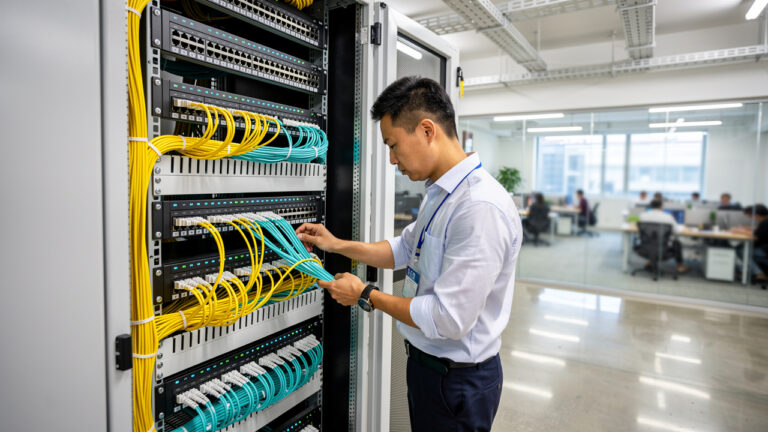
- We design and build network infrastructure, from cabling and racks to routing, switching, and Wi‑Fi tuning. Our engineers plan access point placement around thick walls, machinery, and radio noise, then test real performance on site.
- We design cloud and hybrid IT setups that balance local data needs with global access. This can include local data centers, China‑based cloud accounts, and safe links back to regional or global hubs.
- We handle regulatory work such as CSL, DSL并 PIPL alignment and ICP filings. Our team maps data, prepares documents, and stays on top of changes so clients do not have to track every new rule in detail.
- We provide daily local IT support and procurement management, including manufacturing IT and MES integration. One partner can look after offices, factories, and vendor contracts across China.
总结
Global IT operations China integration in 2026 cannot rely on copy‑paste from other regions. It needs a clear view of local IT reality, a firm grip on CSL, DSL并 PIPL, and a network design that respects the Great Firewall instead of fighting it. On top of that, companies need layered security that deals with both sloppy local habits and higher‑end supply chain risk.
The good news is that these demands are manageable with the right plan and the right local partner. We built NETK5 around this exact need, combining more than two decades of China experience with a service style that puts the business first. Our clients focus on production, sales, and growth while we keep their China IT steady, compliant, and secure.
If your group is planning a new site or struggling with an existing one, we invite you to speak with us. A short discussion or on‑site assessment can give you a clear path forward for your own global IT operations China integration.
FAQs
Question 1 – What are the biggest IT challenges for international companies operating in China?
The main challenges sit in four areas. First, complex data laws such as CSL, DSL并 PIPL shape how systems can be built. Second, the Great Firewall slows or blocks many standard global tools. Third, many local sites start with weak security and informal practices. Fourth, cultural gaps between headquarters and local teams make communication and execution harder unless someone stands in the middle.
Question 2 – How does NETK5 help with PIPL and CSL compliance in China?
We start by mapping what data you collect, where it flows, and who needs to see it. Then we classify that data under PIPL, CSL并 DSL rules and design storage and access paths that stay inside legal lines. Our team prepares ICP filings and other paperwork and tracks new rules from Beijing. In this way, compliance becomes part of the system design, not an extra project.
Question 3 – How long does it take to set up IT infrastructure for a new office or factory in China?
For a normal office, we can often complete design, procurement, and installation in about two to four weeks. This covers cabling, racks, network gear, Wi‑Fi, and basic security. Factories can take longer because they need detailed site surveys, production line links, and MES or OT integration. We plan timelines with both global IT and local operations so start‑up dates are realistic.
Question 4 – Do international companies need a local IT partner in China, or can headquarters manage remotely?
Remote teams alone rarely see the full picture in China. Language gaps, local vendor habits, building rules, and fast‑moving regulations all work against a purely remote model. With NETK5, headquarters keeps control of strategy while we act as the local hands, eyes, and ears. That mix gives you global consistency and reliable on‑site execution for global IT operations China integration.





 Chinese
  English