
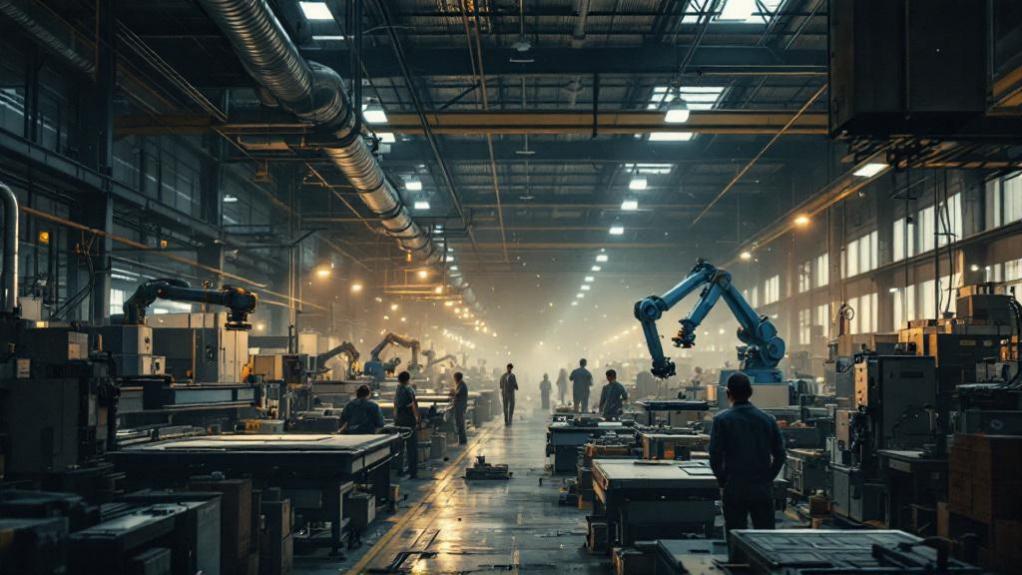
Why Factory Wi‑Fi Keeps Dropping Connections on the Production Floor
Factory Wi-Fi drops connections due to multiple manufacturing-specific factors. Your production equipment generates RF interference, degrading signals by up to 70%. Metal structures create Faraday cage effects and complex reflection patterns, causing dead zones. Mobile devices struggle with inefficient roaming protocols, while channel saturation occurs as devices compete for limited 2.4GHz spectrum. Enterprise solutions like directional antennas, strategic AP placement, and 5GHz migration can resolve these industrial connectivity challenges.
Key Takeaways
- Industrial equipment like VFDs, motors, and welding machines generate RF interference that degrades Wi-Fi signals by up to 70%.
- Metal structures create reflection patterns, Faraday cage effects, and dead zones that significantly attenuate wireless signals.
- Mobile devices struggle with network steering that prioritizes suboptimal access points, increasing connection failures during movement.
- Channel saturation occurs when limited 2.4 GHz bands become overwhelmed by device density and competing signal interference.
- Poor access point placement fails to account for manufacturing floor layout changes and equipment that creates signal null zones.
Industrial Equipment RF Interference: The Hidden Wi-Fi Killer
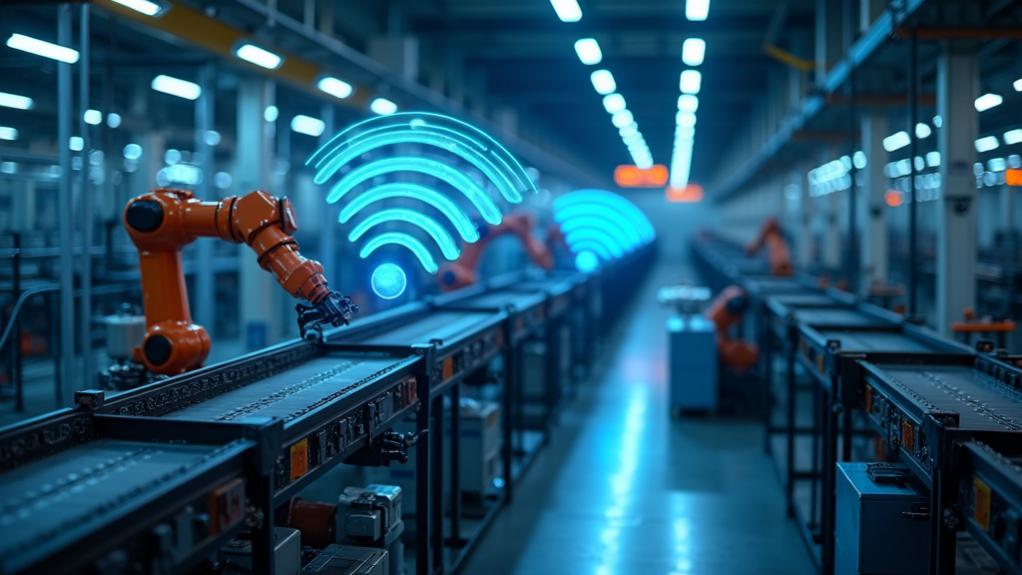
While industrial environments provide the backbone for manufacturing operations, they simultaneously harbor RF interference sources that act as silent adversaries to your wireless network infrastructure. VFDs in conveyor systems and electric motors on roller-shutter doors emit electromagnetic radiation that directly corrupts Wi-Fi radio waves, degrading signal strength by up to 70%. Implementing directional antennas can help mitigate these interference issues by focusing signals away from problematic equipment.
Your team may observe intermittent connectivity as welding machines cycle on, generating broadband interference across the 2.4 GHz spectrum. These disruptions manifest in dropped connections and reduced throughput as devices constantly renegotiate links. Spectrum analysis reveals these noise patterns as erratic spikes across frequency bands, particularly affecting channels 1, 6, and 11. The cumulative effect of multiple interference sources creates null zones where even high-gain antennas struggle to maintain reliable connections, ultimately impacting production metrics your facility depends on.
Metal Structures and Signal Reflections: Creating Factory Dead Zones
Metal structures dominate the industrial landscape, creating a Wi-Fi environment where signals don’t simply travel from point A to point B. Instead, your 2.4 GHz and 5 GHz transmissions encounter complex metal reflection patterns that generate multipath interference.
Factory floors exhibit characteristic 盲区 where solid metal walls completely block signal propagation. These dead spots worsen when production equipment, metal shelving, and inventory create reflection-based interference zones. You’ll notice 2.4 GHz penetrates metal better than 5 GHz, but suffers more interference. Metal walls create a Faraday cage effect that significantly attenuates Wi-Fi signal strength throughout factory environments.
To address these issues, deploy APs at strategic corner positions and crossings. Consider implementing MIMO technology to leverage reflections advantageously. Adding directional antennas concentrates signal around barriers, while metal reflectors can boost signal strength by up to 6.56 dBm. For enclosed metal rooms, the one-AP-per-room approach guarantees reliable coverage.
Mobile Industrial Devices: Managing Roaming Connectivity Challenges

Mobile industrial devices operating across factory environments face unique connectivity challenges that transcend standard Wi-Fi implementations. When these devices roam between access points, they experience performance degradation similar to cellular roaming issues, with latency increasing 3-4× during shifts.
Your factory equipment suffers when network steering prioritizes arbitrary roaming agreements over signal quality, forcing connections to suboptimal access points. This increases connection failures and retry rates, dramatically reducing battery life of handheld scanners and tablets.
Network steering should prioritize actual signal quality rather than predefined roaming agreements to preserve battery life in industrial devices.
Metal structures compound these problems, creating coverage gaps that require devices to remain active longer while searching for viable connections. You’ll notice equipment struggling with higher power consumption as it attempts repeated network scans. The integration of eSIM technology could potentially address these challenges by providing more flexible connectivity options across industrial environments.
To mitigate these issues, implement efficient handoff protocols and evaluate network quality metrics rather than relying solely on predefined roaming pathways that neglect actual signal strength conditions.
Channel Saturation: When Too Many Factory Systems Compete for Airwaves
How severely does your factory’s Wi-Fi infrastructure suffer from channel saturation? Your manufacturing floor likely contends with the 2.4-GHz band‘s limited three non-overlapping channels (1, 6, 11), where device density quickly exhausts available airtime capacity.
When signal interference from microwaves, ZigBee, and Bluetooth devices compounds with physical obstacles reflecting RF signals, your network deteriorates rapidly. Each connected device—whether transmitting video feeds, VoIP communications, or synchronization data—consumes finite channel airtime, often pushing demand beyond 100% capacity.
Modern network planning must prioritize airtime utilization over simple device counts. Consider shifting to 5-GHz bands with their superior non-overlapping channel availability and reduced interference profile. Implementing Dynamic Frequency Selection can automatically identify and utilize the cleanest available channels for optimal communication. Implement AI-powered Radio Resource Management for dynamic channel allocation, automatically selecting best channels as RF conditions change throughout your production facility.
Enterprise Wi-Fi Solutions for Manufacturing Environments
Addressing channel saturation challenges requires implementing enterprise-grade Wi-Fi infrastructure specifically engineered for manufacturing environments. The evolution to Wi-Fi 6/6E and now Wi-Fi 7 standards provides your factory connectivity strategies with multi-link operation capabilities and expanded channel bandwidth—critical features when maneuvering dense device ecosystems on your production floor. Hardware dominates enterprise WLAN implementations, commanding over 60% of market revenues as manufacturing operations shift to edge-AI compatible access points. With a projected CAGR of 8.8% from 2025 to 2033, industrial WLAN solutions are becoming increasingly essential for factory operations seeking reliable connectivity.
- Deploy multigig Ethernet switches supporting 2.5/5 Gbps throughput with 90W PoE for next-gen access points
- Implement channel optimization protocols to mitigate RF interference in metal-rich environments
- Utilize cloud-managed WLAN services for centralized configuration of distributed access points
- Configure enterprise network optimization with QoS policies prioritizing mission-critical production traffic
Frequently Asked Questions
How Do Seasonal Temperature Changes Affect Wi-Fi Reliability in Factories?
Your network experiences thermal degradation as seasonal shifts introduce temperature impact beyond component tolerance thresholds. You’ll encounter signal attenuation and humidity effects causing PCB condensation on your industrial access points.
Can Conveyor Belt Speed Impact Wireless Connection Stability?
Yes, your conveyor’s speed directly affects wireless stability through vibration-induced signal interference. You’ll need adaptive maintenance protocols to mitigate RF distortion when operating at higher velocities.
Does Shift Change Network Traffic Cause Predictable Connectivity Problems?
Like clockwork, shift changes trigger predictable connectivity problems. Your worker mobility patterns and shift duration variables create quantifiable throughput degradation, causing bandwidth contention when multiple devices simultaneously authenticate to your access points.
How Often Should Factory Wi-Fi Hardware Be Replaced?
You’ll need to replace your factory Wi-Fi hardware every 3-5 years for ideal performance. This upgrade frequency aligns with industry standards, ensuring hardware lifespan isn’t compromised by technological obsolescence or environmental stressors.
Will 5G Private Networks Eliminate Wi-Fi Dependency in Manufacturing?
Like a fortress replacing a picket fence, 5G advantages include deterministic latency and private network security benefits. You’ll phase out Wi-Fi dependency through dedicated spectrum allocation, enhanced URLLC capabilities, and cellular-grade authentication protocols.
总结
You’re facing the perfect wireless storm on your production floor—RF propagation through a gauntlet of metal reflectors, 2.4GHz harmonics from VFD motors, and catastrophic co-channel interference. Don’t wait until your MES terminals drop like flies during peak production. Implement 802.11ax APs with directional MIMO antennas, configure aggressive RSSI thresholds, and deploy WPA3-Enterprise authentication. Your throughput will skyrocket while latency plummets to microsecond levels.


 Chinese
  English